
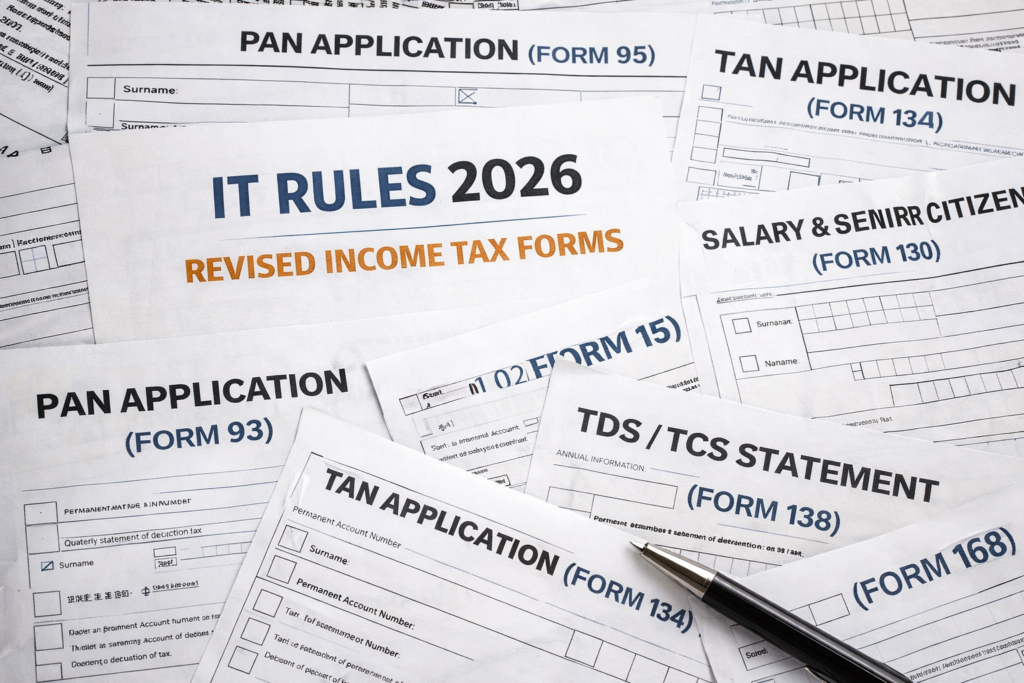
Key Changes in IT Rules 2026 Revised Forms
The Draft Income Tax Rules, 2026 introduce a structural recasting and serialised listing of statutory forms, while largely retaining the substance of forms prescribed under the Income Tax Rules, 1962.
Although the core statutory requirements remain similar, the form numbers have been reorganised and renumbered. As a result, many forms under the 1962 Rules now appear under different serial numbers in the Draft IT Rules, 2026.
1️⃣ Key PAN & TAN Related Forms
The 2026 Rules reorganise PAN and TAN application forms based on the applicant category:
- Form 93 & 94 – PAN application for Indian citizens, companies, and entities incorporated in India (Earlier Form 49A)
- Form 95 & 96 – PAN application for non-residents and foreign entities (Earlier Form 49AA)
- Form 134 & 135 – TAN application forms under Section 397 (Earlier Form 49B)
The segregation now clearly distinguishes between resident, non-resident, government, and non-government applicants.
2️⃣ Salary, Perquisites & Senior Citizen Forms
Several salary-related forms have been renumbered but retain their original purpose:
- Form 123 (Earlier 12BA) – Statement of perquisites and fringe benefits
- Form 124 (Earlier 12BB) – Employee declaration for tax deduction claims
- Form 125 (Earlier 12BBA) – Declaration for specified senior citizens
- Form 130 (Earlier 16) – TDS certificate for salary and specified income
- Form 131 (Earlier 16A) – TDS certificate for non-salary payments
The restructuring improves logical grouping under salary and senior citizen compliance.
3️⃣ TDS / TCS Statements & Declarations
The quarterly TDS and TCS reporting forms have also been renumbered:
- Form 138 (Earlier 24Q) – TDS on salary
- Form 140 (Earlier 26Q) – TDS on non-salary payments
- Form 144 (Earlier 27Q) – TDS on payments to non-residents
- Form 143 (Earlier 27EQ) – TCS return
- Form 121 (Earlier 15G / 15H) – Declaration for non-deduction of tax
- Form 127 (Earlier 27C) – Declaration for non-collection of TCS
The new numbering aligns TDS and TCS provisions under updated statutory sections.
4️⃣ Foreign Payments & Cross-Border Compliance
For international taxation and foreign remittances:
- Form 145 (Earlier 15CA) – Information for payments to non-residents
- Form 146 (Earlier 15CB) – Chartered Accountant certificate for foreign remittance
- Form 41 (Earlier 10F) – Information under tax treaty provisions
- Form 42 & 43 (Earlier 10FA & 10FB) – Tax residency certificate process
- Form 44 (Earlier 67) – Foreign tax credit statement
The structure continues to support cross-border compliance and treaty reporting.
5️⃣ Appeals, Disputes & Proceedings
Forms relating to tax appeals and dispute resolution have been reorganised:
- Form 99 (Earlier 35) – Appeal before Commissioner (Appeals)
- Form 115 (Earlier 36) – Appeal before ITAT
- Form 116 (Earlier 36A) – Cross-objections before ITAT
6️⃣ Information Statements & Reporting
- Form 168 (Earlier 26AS) – Annual Information Statement
- Form 165 (Earlier 61A) – Statement of Specified Financial Transactions
- Form 166 (Earlier 61B) – Reportable account statement
The AIS (Annual Information Statement) continues to play a critical role in tax transparency.
7️⃣ Audit & Transfer Pricing Forms
Audit and transfer pricing compliance forms remain substantively unchanged but renumbered:
- Form 26 (Earlier 3CA/3CB/3CD) – Tax audit report
- Form 24 (Earlier 3CE) – Audit report under specific provisions
- Form 48 (Earlier 3CEB) – Transfer pricing report
- Form 49 (Earlier 3CEFA / 3CEFB / 3CEFC) – Safe Harbour application
Key Takeaways
- The Draft IT Rules, 2026 primarily introduce renumbering and structural reclassification of forms.
- Substantive compliance requirements largely remain similar to the 1962 Rules.
- Tax professionals and businesses must carefully update references to form numbers under the new framework.
- The revised serialisation enhances logical grouping and alignment with updated statutory provisions.
Conclusion
The structural recasting under the IT Rules, 2026 represents a compliance alignment exercise rather than a radical overhaul. While the core documentation and reporting requirements continue largely unchanged, taxpayers, professionals, and businesses must familiarise themselves with the updated numbering system to ensure accurate filings under the new regime.
Disclaimer: This article is for educational purposes only and should not be considered professional tax advice. Readers are advised to refer to the official Draft Income Tax Rules, 2026 and consult a qualified tax professional before taking any compliance action.
For understanding GST compliance under the Income Tax and indirect tax framework, read our detailed guide on GST Registration in India – When Is It Mandatory?
👉 https://ipounlock.com/gst-registration-in-india-when-is-it-mandatory/
If you are exploring tax planning options, you can also learn how HUF can help in tax saving in India in our beginner-friendly guide here:
👉 https://ipounlock.com/how-to-save-tax-using-huf-in-india-simple-guide-for-families/